Showing posts with label Nature Journal. Show all posts

Tuesday, February 26, 2013

Natural Collections

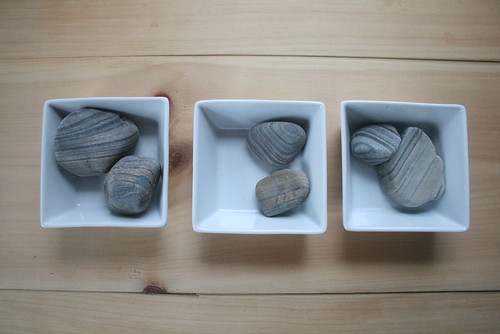
I recently started my own collection of striped rocks. And I've been inspired by so many other forms of natural collections...


Rock Collection

My own collection of rocks.


Monday, February 25, 2013

Tiny Greenhouses

I have long been a fan of the tiny trend- tiny houses, tiny cabins, tiny cars. Since we aren't in the market to build our own tiny cabin quite yet, I've decided to spend this cold wintery day dreaming up plans for a tiny greenhouse.


The key to a tiny greenhouse is salvaged materials. Many creative builders across the web have demonstrated what a few discarded windows can give you. Whenever I see windows at yard sales I scoop them up because even if you aren't going to build a tiny greenhouse, you could certainly use the windows for a simple removable cold frame.


Source (links to Finnish Company)

Thoughtful placement is also a very important aspect to the tiny greenhouse. Maximize your passive heating and energy by locating the windows to the south, where the most direct sunlight will help warm up the greenhouse.


Sunday, February 24, 2013

The Great Eskimo Vocabulary Hoax

Tecumseh Winter

Do Eskimos really have the largest snow vocabularies? For years, linguists have theorized that Eskimos in fact have accumulated the largest vocabularies in regards to snow, also known as the Sapir-Wharf hypothesis. The main idea being, that the more you know something, the more you experience it and the more you think, see, and touch something the greater your variety of language around it. Since Eskimos have vast experiences with snow, the idea that they may have the most varied and complex ways to describe it sounds logical.

Over the years "The Eskimo Vocabulary Hoax" has countered this hypothesis, stating that Eskimos in fact do not have the largest snow vocabularies. Linguists behind the Hoax theory point out that several Eskimo languages (Inuit, Yupik) vary their root words by adding any number of prefixes to them. By changing their root words in this way, Eskimos have dozens upon dozens of ways to really describe anything, not just snow.

So it seems that Eskimo languages are really more flexible in the way that they create vocabulary by adding prefixes, not that they have the largest snow vocabularies. Although the idea behind the Sapir- Wharf hypothesis still resonates with me. Based on the winter we have had here in New England my snow vocabulary is certainly growing (up to 12 different words!). Care to add to the list? Let me know what I am missing...

snow. powder. dusting. fluff. hardpack. slush. sleet. snowflake. flurry. avalanche. hail. frost.
Wednesday, January 30, 2013

Nature Journal: Tree Rings


What can a simple cross section of a tree reveal? Much more than just it's age to the savvy well-trained eye. Each year a tree forms a new tree ring, which is essentially a new layer of cambium, the layer of the tree responsible for moving food and nutrients between the roots and the tree itself. By counting these rings the tree's age can easily be determined. Spend a bit more time and examine the distance between the rings and you may learn about the tree's life.

Tight narrow tree rings indicate less favorable conditions than the wider more generously spaced rings.The spacing between the rings reveals a story about the tree's life and environmental conditions. A tree with narrow rings may be a tree that suffered through a multi-year drought or perhaps encountered difficulty finding enough nutrients, sun, or proper soil composition. Sudden widening of rings may indicate a larger competitor for light had fallen that year.

Enjoy the study of tree rings as much as I do? Check out the book Woodcut by Bryan Nash Gill. Gill is an artist who makes his own one of kind stamped images from tree rings.

Sunday, January 27, 2013

The Art of the Holz Hausen Woodpile

If you have ever had a woodpile avalanche--- the sudden spill of your neatly stacked woodpile into a messy pile--- you've probably thought- there has to be a better way! Enter the Holz Hausen woodpile, a method of stacking wood in a cylindric pile that allows for better air circulation (think better drying!) and more security if built properly.


The Holz Hausen's circular form allows air to "chimney" up through the center of the wood creating it's own circulation system, thus drier wood. It's considered more stable than your traditional woodpile because it utilizes a circle as a base. Plus, all those random small and oddly shaped pieces of wood have a home in the Holz Hausen! No more oddly leaning woodpile with random slices of wood sitting around waiting for a spot.

Quite frankly a Holz Hausen woodpile calls to the passerbys and onlookers. I can't tell you how many people used to comment on ours. It's sort of a backwoods tourist attraction.

Interested in a more detailed how-to? Check out this video....

Thursday, January 24, 2013

Stacking Wood


There is nothing more satisfying than stacking your own wood into a neat little woodpile. It’s been several years since we have heated by wood, but I remember it fondly each time we venture off to one of our favorite vacation spots in Northern Maine.


A carefully planned, stacked, and dried woodpile means easier living in the winter months. Placed nearby a door and you can pop in and out with the winter winds are blowing and grab a few pieces without freezing your buns off.

Wood is purchased by a measurement called a cord. One cord of wood is equal to roughly 4x8 feet of stacked wood or roughly 128 cubic feet. A few cords of wood will warm a small to medium sized house for a winter.

Just as there are this is more than one way to skin a cat, there is more than one way to stack your firewood.When determining where to stack your wood, look for someplace with a lot of direct sun to help dry out the wood. Having a garage wall or gate to line the wood up against is also a great idea and should still dry appropriately given time.

The most traditional way to stack wood is by creating a long single stack of wood. Stack a few pieces at a time and then turn the next line of wood in the opposite direction. This is called cribbing and is absolutely necessary to avoid an avalanche of wood when the wind blows. By the way, nothing stacks wood quicker than stopping to sip a beer. So I definitely recommend considering that as well.

Wednesday, January 23, 2013

Origins of the New England Stonewalls

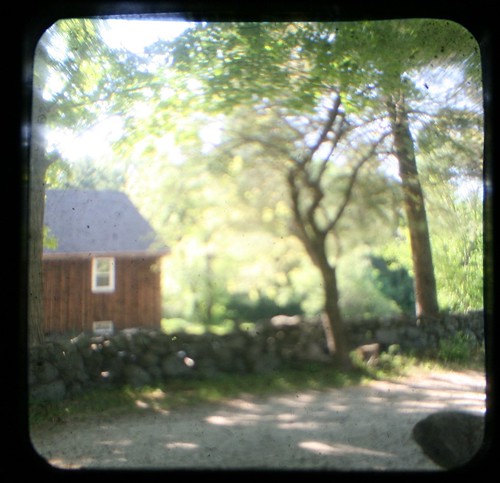
Stonewall Barn

A lifelong New Englander, I have always thought the many hundreds upon hundreds of stonewalls that litter our region were originally property markers that marked the edges of owners land. It turns out that these amazing (and backbreaking!) works were originally built for an entirely different purpose.

In the early 1800s the United States government placed a tariff on all goods from England and this included wool and wool products. The need for wool for early settlers was great as it was a good that could spun, woven, or knitted at home to create warm clothing and blankets. Roughly the same time, a small flock of merino sheep were introduced to the area and their incredibly soft wool was highly prized. Not long after, a "sheep craze" took over the area and nearly every small farm had their own flock.

Keeping the thousands of sheep in separate fields across the region was no easy feat. Acres and acres of forested land were cut down for grazing fields for the sheep. In fact, the deforestation of New Hampshire and Vermont in the mid 1800s was due, in large part, to this sheep craze.

Soon farmers were building very large (four feet tall) stone walls to keep their tiny hoved flocks together. Since a flock of sheep could ravage someones crops in short time, these high walls were enforced by law and fines were high for any field found lacking.

Tuesday, January 22, 2013

For the Love of Fire


If you’ve been to my pinterest boards lately you’ve probably noticed how obsessed I am with fire and wood. There is something so wonderfully rustic and honest about fires. Have you ever been on a long camping trip and come back to your site to build a fire? It warms more than just your body that’s for sure. Sitting by a fire does something good for your spirit. It builds you back up.

I had been planning on spending the month of February writing some bits and pieces about fire, stacking wood, and starting a fire, but I think I will start early.


My upcoming posts will include a little of the following:

  • How to make a woodpile
  • What’s there to a woodpile anyway?
  • The Art of the Holz Haussen woodpile
  • How to start a fire
  • Starting a fire in harsh conditions- windy and wet


This week will bring record cold up here in the Northeast and thinking about fire will help keep me warm….

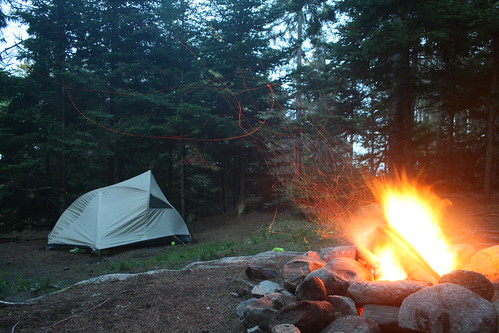
Tent by Campfire

Monday, January 21, 2013

Becoming a Scout Bee

Bee Happy


Bee colonies are comprised of several different “bee occupations” if you will. The queen bee's, we all know well, sole occupation is to create more bees. Worker bees, well, work by collecting pollen from flowers and maintaining the hives perfect temperature control, among other things. Of course there is the drone bee and my favorite- the scout bee.

The scout bee’s primary job is, when the time is right, to spend their time exploring cracks in the roof, tree branches, and mountain nooks to find the perfect place to relocate their hive. Scout bees start their lives as forgers, or worker bees, destined for finding, collecting, and maintaining group harmony. Somewhere along the way of their short little lives, scout bees change their flight path from forager to finder and become a scout bee.

But how does one bee out of the masses of worker bees become a scout bee? Well, scientists have recently identified changes in brain chemistry that can “turn on” the adventure in non-scout bees. Indicating that while scouts require certain hive circumstances (mainly a queen without a home and a hive that isn’t too hungry) to initiate their scout instinct, they are somewhat genetically, or at least neurochemically predispositioned to seek out new terrain.

Brains of Bee Scouts, The New York Times
Honeybee Democracy, Thomas D. Seeley

Introducing the Nature Journal

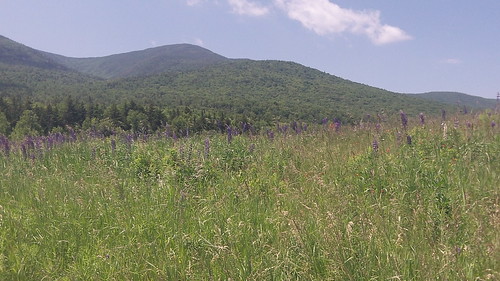
Mount Tom

A lifelong lover of the outdoors I have always found myself to be fascinated with it. Spend enough time on the trail or sitting outdoors and soon you'll be curious about the smallest of things- the clusters of flowers by the trail's edge, the preponderance of ticks and the names of trees.

My blog here at Betty Mountain Girl has always been a place to share- adventure, the outdoors, and now nature. I'll be writing a new section for the blog called The Nature Journal. You can follow this section by looking through my tags for Nature Journal. The bits and bobbles I plan to post will include my notes, research, and observations on the things that make up the spaces I seek. Please enjoy the ride!